Comparison
Machining vs Casting: Why the 80/20 Rule Matters More Than Ever
May 15, 2026
Fully machining parts from solid stock is often the default — but at scale, it's rarely the most economical choice. The 80/20 casting rule can change your cost structure entirely.
The Problem with Machining Everything
In manufacturing, cost rarely comes from what doesn't add value. It comes from doing too much of what doesn't.
Fully machining parts from solid stock is often the default — but at scale, it's rarely the most economical choice. Every extra setup, toolpath, and cubic inch of removed material quietly inflates cost without improving function.
The 80/20 Casting Rule
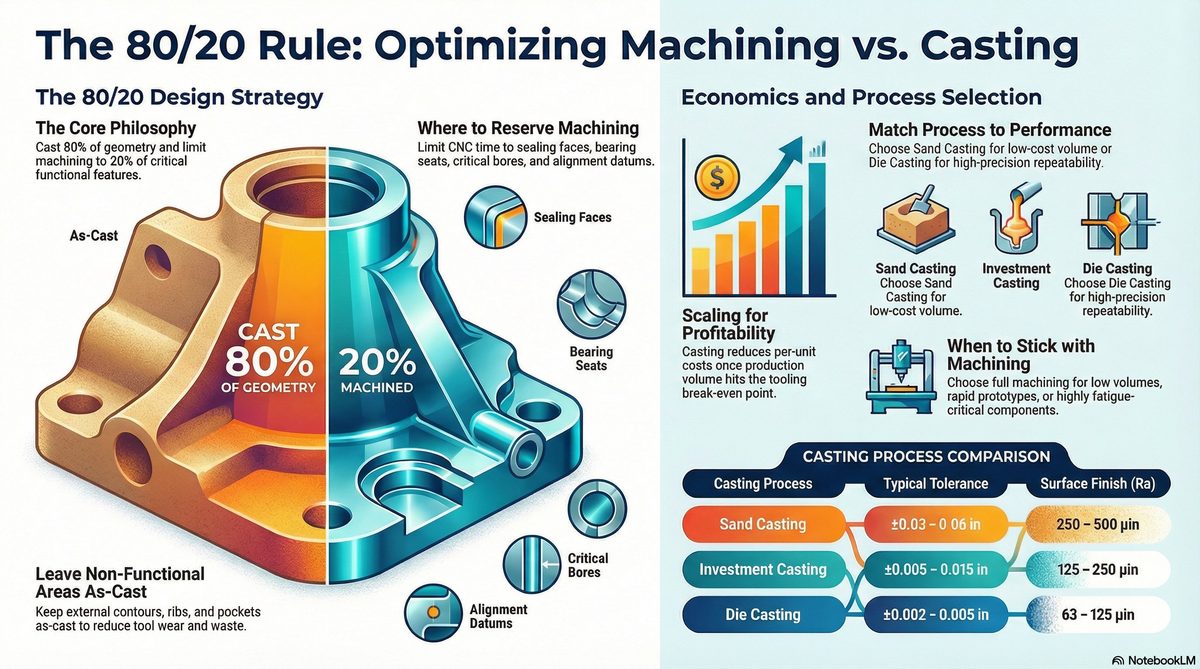
A smarter approach is the 80/20 casting rule: design parts so roughly 80% of the geometry is produced by casting, and reserve machining for the 20% that truly matters.
That critical 20% includes:
- Sealing faces
- Bearing seats
- Critical bores and datums
- Threaded interfaces
Everything else — ribs, pockets, contours, non-critical surfaces — should work for you as cast geometry, not against you as machining time.
Why This Matters Now
Because volumes are rising, margins are tighter, and customers expect both cost efficiency and quality. Near-net-shape casting reduces:
- Raw material waste
- CNC machine hours
- Tool wear and setups
- Per-unit cost at scale
Casting Process Comparison
| Process | Typical Tolerance | Surface Finish (Ra) |
|---|---|---|
| Sand Casting | ±0.03 – 0.06 in | 250 – 500 μin |
| Investment Casting | ±0.005 – 0.015 in | 125 – 250 μin |
| Die Casting | ±0.002 – 0.005 in | 63 – 125 μin |
When to Stick with Full Machining
Full machining from solid stock remains the right choice for:
- Low volume or one-off parts
- Rapid prototypes before tooling investment
- Highly fatigue-critical components where grain flow matters
- Parts with geometry that cannot be cast economically
When to Choose Casting + Finish Machining
Once production volumes justify tooling investment, the break-even math shifts quickly. Casting reduces per-unit cost at scale while finish machining delivers the precision where it counts.
The most successful cost reductions do not come from squeezing suppliers or cutting corners. They come from better design decisions upstream, made early and intentionally.
The Bottom Line
If you are still machining parts that are mostly non-functional geometry, it may be time to ask a simple question: what really needs to be machined — and what does not?
That answer can change your cost structure entirely.
At Bhurjee Industries, we work with customers at the design stage to identify machining-to-casting transition opportunities. If you are scaling production of a machined component, request a consultation and we will review the economics with you.
LET'S BUILD TOGETHER
Ready to start your next project?
Get a quote with full material traceability and documentation from day one.