Industry
When "316 Stainless" Isn't Always the Same Material
July 8, 2026
Two heats of 316L from different mills. Same grade, same cert, same cutting parameters — completely different behaviour under the tool. The MTRs revealed a single variable that was 40× different between them.
The Problem
We recently ran a job requiring 316 stainless steel — a 9" round bar, bored from a 2-3/8" starting diameter out to a 6" ID, 8 inches deep. It's a job we've run before, using the same grade of material we always spec for it.
This time, our usual heat wasn't available in time to hit the customer's deadline. To keep the job on schedule, we sourced 316L from a different steel mill. Same grade, same spec, same certification requirements. On paper, a like-for-like substitute.
It didn't cut like one.
What Changed
Normally, this operation finishes on a single insert corner, no problem — we can walk away and let the machine run unattended for the full cycle.
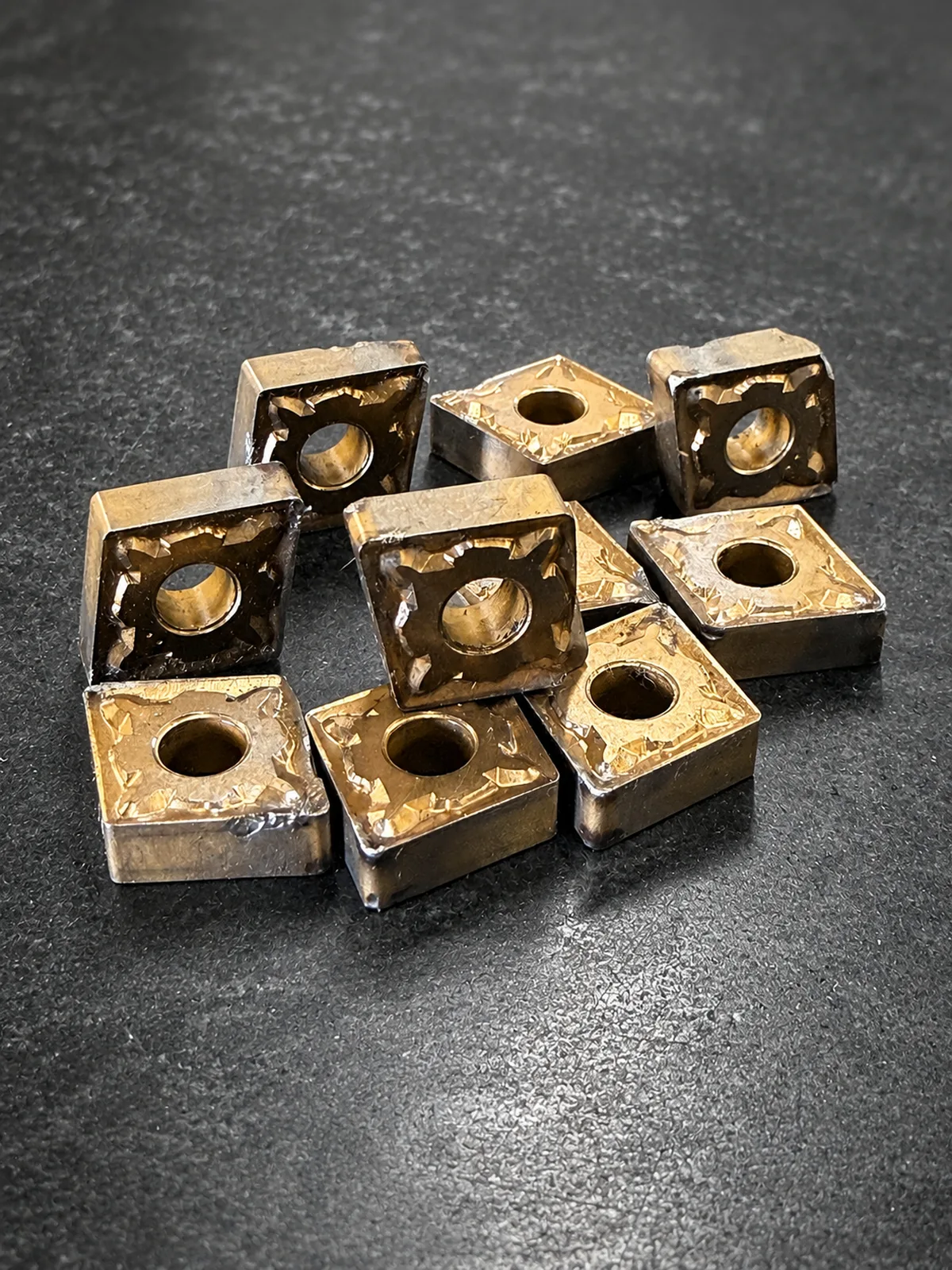
With the substitute material, we burned through three corners on the same operation, and couldn't leave the machine unattended at any point. The risk of an edge failure was real enough that it needed to be watched start to finish.
Nothing about our setup changed — same insert family appropriate to the tooling, cutting parameters well within the insert manufacturer's rated window for both jobs. The only variable was the steel itself.
Why "316" Isn't One Material
316 stainless is a specification, not a single recipe. Two mills can each pour a heat that fully meets ASTM A479/UNS S31600 and land in noticeably different places within that spec — different melt practice, different secondary refining, different trace element targets.
We pulled the Mill Test Reports (MTRs) for both heats and compared them side by side: chemistry, mechanical properties, hardness, grain size, corrosion testing. The overwhelming majority of the numbers were close enough to be a non-issue — strength, hardness, and general alloying content were all within a few percent of each other, and both heats comfortably exceeded spec minimums.
One variable stood out: sulfur content. Our usual heat came in at 0.026% sulfur. The substitute heat measured 0.0006% — roughly 40 times less. Every other major figure on the two certs (yield, tensile, hardness, general alloying content) was within a few percent. Sulfur was the outlier, and not by a small margin.
Sulfur in 316 forms manganese sulfide (MnS) inclusions distributed through the microstructure. In small, controlled amounts, they act as internal chip-breakers — they give the chip somewhere to shear cleanly, which lowers cutting forces and helps the chip curl away from the tool instead of smearing across it. Steel producers actually target a certain sulfur range specifically to improve machinability, without compromising the corrosion resistance the grade is chosen for in the first place.
The substitute heat we received was essentially at the bottom of the allowable sulfur range — metallurgically "cleaner," but without that internal chip-breaking mechanism. In most cutting operations, that difference is manageable. In an 8"-deep bore, it's a different story: there's nowhere for a long, stringy chip to go except back into the tool. Poor chip control in a confined bore compounds fast — heat builds at the edge, material adheres to the insert, and edge life drops sharply.
We ran the substitute material at 350 SFM — within the insert manufacturer's rated cutting speed for that tooling, so this wasn't an overspeed condition. The tool wear we saw was consistent with the chemistry, not the parameters: chipped and fractured cutting edges, visible built-up material welded onto the corners, and discoloration indicating elevated cutting temperature — the signature of adhesion and mechanical overload, not simple abrasive wear.
The Takeaway
Two mill certs, two "316L" stampings, two very different days on the machine. The grade name on a spec sheet tells you the material meets a minimum bar — it doesn't tell you how the heat will actually behave under the tool, especially in geometry-constrained operations like deep boring where chip evacuation is doing half the work.
For us, it's a reminder to pull and compare MTRs whenever a substitute heat comes in on a job with tight tolerances or difficult geometry — not just to check the box on certification, but to actually understand what we're about to put in the spindle.
Client name withheld for privacy.
LET'S BUILD TOGETHER
Ready to start your next project?
Get a quote with full material traceability and documentation from day one.